Ayris CRM
First deal kit
Ayris CRM - Built by wholesalers, for wholesalers
The First Deal Kit: How to Find and Wholesale Your First Real Estate Deal
A Step-by-Step Beginner's Guide to Finding Sellers, Analyzing Properties, Getting Contracts, and Finding Cash Buyers
You don't need a huge marketing budget to start looking for wholesale real estate opportunities. You need a repeatable process, a willingness to talk to property owners, and an understanding of how a wholesale transaction actually works.
A lot of people spend months watching videos about real estate wholesaling without ever taking the first step.
They research the perfect business name. They shop for expensive lead lists. They watch somebody explain how they made $20,000 on a deal, then search for another video instead of making a call.
You can spend a lot of time preparing to start a wholesaling business without actually starting one.
This First Deal Kit is designed to change that.
I'm going to walk you through 11 steps, starting with Google Maps and finishing with the title company.
You'll learn how to identify potential properties, research ownership, organize your leads, speak with sellers, gather property information, make offers, get a properly structured contract, work with another wholesaler, and prepare for a closing.
You can use free research tools for much of the initial process. A CRM, document-signing service, professional assistance, title work, and other transaction needs may involve costs.
This isn't a promise that your first deal will close or that you'll make a certain amount of money. It's a practical framework for learning how the business works and taking meaningful action.
Already have a property under contract but need a buyer?
JV Hotline: 810-874-2725
First, Understand What Real Estate Wholesaling Actually Is
Real estate wholesaling is a strategy in which an investor identifies a property opportunity, negotiates a purchase agreement with the owner, and may transfer their contractual interest to another qualified buyer when the agreement and applicable law permit it.
Instead of buying and renovating every property yourself, you may be able to assign your purchase rights to an end buyer for an agreed fee.
Here's a simple illustration.
A property owner agrees to sell for $60,000.
You've researched the property, its condition, and local investor demand. A qualified investor is willing to pay $70,000 for the contractual opportunity.
If the agreement is legally assignable, the transaction is properly structured, all parties understand the relevant terms, and the closing is completed, the difference could provide a $10,000 gross assignment fee.
That does not mean every $60,000 contract is worth $70,000. It does not account for every possible transaction expense, and it does not guarantee a buyer or closing.
The important lesson is that your fee must be supported by a legitimate opportunity and an end buyer willing and able to complete the transaction.
You need a workable purchase price, a clear contractual right, reliable property information, and a title or closing professional who understands the transaction.
Also understand the difference between assigning your own contractual rights and acting as a broker who markets somebody else's property for compensation. Licensing and disclosure requirements vary by jurisdiction, and calling an agreement an "assignment" does not automatically make every activity lawful.
Before beginning, understand the laws where you plan to operate and have an appropriate real estate attorney or qualified professional review your transaction documents and intended process.
Now let's get started.
Step 1: Open Google Maps and Pick an Area
Your first task is to start identifying properties that might be worth researching.
You do not need to begin by purchasing a list of 10,000 homeowners.
Open Google Maps and start learning one area.
Choose a Market You Can Understand
For your first search, choose one city, neighborhood, or ZIP code.
You might begin in a market you're already familiar with, such as Flint, Burton, Detroit, or another city where you understand the local housing stock.
Don't jump randomly between dozens of markets.
A smaller geographic focus makes it easier to learn the differences between streets, property conditions, sale prices, and investor preferences.
For example, two houses might be only a few blocks apart but appeal to completely different buyers.
One neighborhood might have strong rental demand. Another might attract flippers. A third might have properties with significant renovation needs and less consistent investor activity.
The more you understand your target market, the better you'll become at recognizing potential opportunities.
How to Search
- Visit Google Maps.
- Search for a city or neighborhood you want to explore.
- Zoom into residential streets.
- Open Street View where it's available.
- Look at individual houses and their surroundings.
- Record addresses that deserve further research.
Use Google Maps as a research tool, not as proof of a property's current condition. Street View imagery may be months or years old.
What Should You Look For?
As you explore neighborhoods, pay attention to possible signs of deferred maintenance.
Examples include:
- Damaged or aging-looking roofs.
- Overgrown landscaping.
- Broken or boarded windows.
- Peeling exterior paint.
- Visible exterior deterioration.
- Properties that appear vacant or neglected.
- Significant differences between a property's appearance and neighboring homes.
These are reasons to research a property, not proof that it is vacant, distressed, for sale, or owned by someone motivated to sell.
A homeowner may have intentionally postponed cosmetic improvements and still have no interest in selling.
Your goal at this stage is simply to identify possible leads.
Your First Assignment
Pick one ZIP code.
Spend some time exploring the residential streets and identify 20 properties that might deserve additional research.
Write down the address, city, ZIP code, and what caught your attention.
Don't worry about whether every property turns into an opportunity.
You're building the habit of finding and evaluating potential leads.
Checkpoint: You should finish Step 1 with a focused geographic area and a list of addresses to investigate.
Step 2: Identify Properties That May Need Work
Finding houses is easy. Identifying properties that could make sense for an investor is where the real learning begins.
A house that looks rough isn't automatically a wholesale opportunity.
You need to understand whether a property may offer an economic opportunity for a buyer after accounting for its purchase price, repair needs, transaction costs, and expected resale or rental performance.
Learn to Recognize Different Types of Properties
A lightly outdated property might only need painting, flooring, and cosmetic improvements.
A heavily distressed property could require roofing, heating, electrical, plumbing, foundation work, or extensive interior renovation.
Those are two completely different opportunities.
A rental investor might accept cosmetic problems but be concerned about major mechanical systems.
A flipper might want a much larger difference between purchase price and after-repair value.
As you research properties, begin asking yourself:
- Is this primarily a cosmetic renovation?
- Could the roof or major systems require replacement?
- What condition are comparable houses in?
- What are renovated homes actually selling for nearby?
- Are investors purchasing properties in this neighborhood?
- What repairs could affect the buyer's required budget?
You won't know every answer from Google Maps.
That's okay. You're learning which questions need to be answered before making an offer.
Don't Confuse a Cheap Property With a Good Deal
A house priced at $40,000 isn't automatically a bargain.
If it requires $70,000 in repairs and comparable renovated houses are only selling for $105,000, the numbers may not work.
On the other hand, a more expensive house with manageable repairs could be a better opportunity.
The purchase price means very little without understanding the property's value and condition.
Build a Research List, Not a Guessing List
For each address, record:
- Property address.
- Neighborhood or ZIP code.
- Visible condition concerns.
- Approximate property size, if verified.
- Property type.
- Any recent public sale information.
- Why you believe it deserves further investigation.
You can use county property records, local assessor information, and actual sold-property data to help verify your research.
Don't rely on AI-generated estimates or online home-value estimates as confirmed appraisals.
Checkpoint: You should have a list of properties and a short explanation of why each might be worth contacting the owner about.
Step 3: Research the Owner and Look for Contact Information
Once you've identified a property, the next step is to determine who owns it and whether there's an appropriate way to contact them.
Start With Ownership Records
Before searching for telephone numbers, verify the owner using available county, municipal, or assessor records.
Confirm the owner's name and property address.
Where available, also note the tax mailing address and whether the owner appears to be an individual, business entity, or trust.
These records can help you avoid contacting the wrong person.
You may also discover that the property has changed ownership since the Street View image was captured.
Using TruePeopleSearch
A free people-search directory such as TruePeopleSearch may help you locate possible telephone numbers associated with a name and location.
However, people-search information can be outdated, incomplete, or incorrect.
You might find multiple people with similar names, numbers belonging to former residents, or contact details that aren't connected to the current property owner.
Treat the information as an unverified lead, not confirmation of ownership or permission to call.
Follow the directory's terms of use and applicable privacy laws.
Before You Contact Anyone
A publicly discoverable phone number is not automatically permission to make a marketing call or send a promotional text.
Real estate acquisition outreach can raise federal and state telemarketing, Do Not Call, consumer-protection, and privacy requirements.
Before conducting cold outreach, understand which rules apply to your specific activities, check applicable suppression lists, honor opt-out requests, and avoid unauthorized automated calls or messages.
If you can't confirm that a call or text is permitted, use another lawful contact method or obtain appropriate professional guidance first.
Organize the Information You Verify
Keep the following information together:
Owner name.
Property address.
Mailing address, where available.
Possible telephone number and its source.
Date the information was researched.
Contact eligibility or restriction status.
Notes about the property.
Your next permitted action.
The goal is to know what you've verified, what is only a possibility, and what still needs work.
Checkpoint: Your property research should now connect potential addresses to verified ownership information and appropriate next steps.
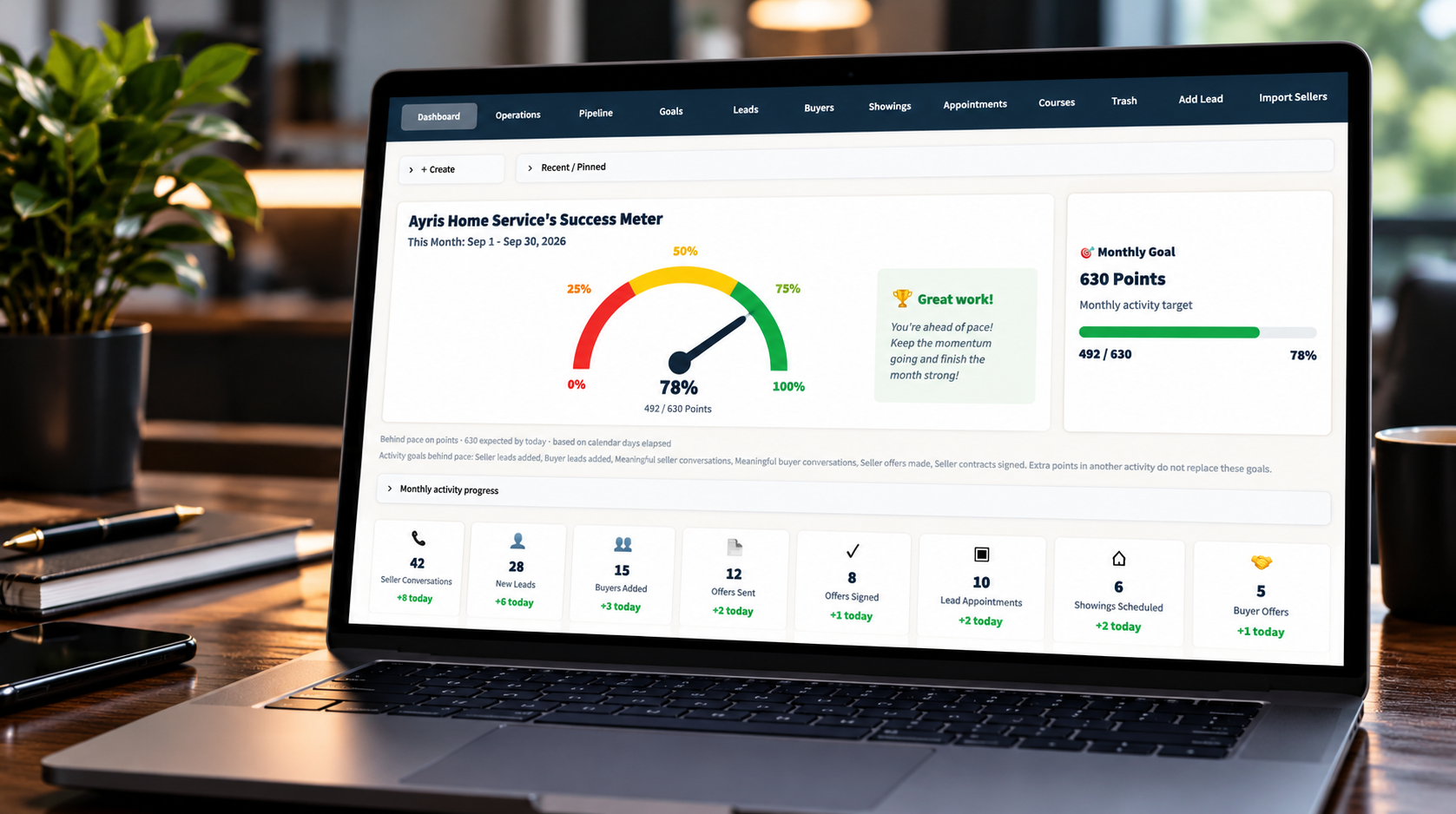
Step 4: Put Every Lead Into a CRM Like Ayriscrm.com
This is one of the steps beginners underestimate most.
You can spend hours finding potential properties and completely waste that effort if you don't organize what you've learned.
Imagine finding 50 addresses this week.
Next week, you find another 50.
Now you have 100 properties and scattered notes, but you can't remember which owners you've already researched, which ones asked for a follow-up, and which properties still need photos.
That's how leads begin slipping through the cracks.
Why a CRM Matters
A customer relationship management system, or CRM, is where you organize your prospects and track the actions needed to move an opportunity forward.
A wholesaling-focused system should help you see more than names and phone numbers.
You want to know the property, the seller's situation, the repairs, the offers, and what needs to happen next.
That's why I recommend keeping your wholesale leads in Ayriscrm.com.
It's built specifically around real estate wholesaling workflows.
A spreadsheet can work when you're starting. The important thing is to use a reliable system consistently rather than depend on your memory.
What to Enter for Every Property
Create a separate lead record for each property opportunity.
Include as much verified information as you have:
Property information
Address, city, state, ZIP code, property type, bedrooms, bathrooms, square footage, and known condition.
Ownership information
Verified owner name, appropriate contact information, and any ownership details you have confirmed.
Seller information
Why they're considering selling, their desired timing, their expectations, and any relevant details they voluntarily provide.
Property condition
Known repair needs, items requiring inspection, photographs, and preliminary cost estimates.
Transaction information
Possible offer price, estimated ARV, buyer requirements, contract status, and applicable deadlines.
Next action
What needs to happen next, who is responsible, and when it should happen.
The Most Important CRM Habit
Never finish a meaningful seller interaction without recording what happened and deciding what the next appropriate action is.
Did they ask you to call back after speaking with a family member?
Record that.
Are they waiting for a tenant to move out?
Record that.
Did they say they don't want further contact?
Record that and respect it.
Are you waiting on interior pictures?
Make that the next task.
Your CRM should help you know what needs to happen next, not simply store a growing collection of names.
You can explore the wholesaling workflow at Ayriscrm.com.
Your First Assignment
Enter the properties you identified into your CRM.
Confirm you can search for an address, review its research notes, and see what work remains.
Don't assume you've finished organizing a lead just because you entered a property address.
Checkpoint: You should have an organized lead list with clear research status and next actions.
Step 5: Call the Seller and Find Out Whether They Want to Sell
This is the part many beginners avoid.
Finding properties feels productive. Studying Google Maps feels productive. Learning contract terminology feels productive.
But a wholesale opportunity usually begins with a real conversation.
If you have an appropriate legal basis to contact a property owner, your goal is to learn whether they have any interest in selling and whether a direct purchase could meet their needs.
You're not trying to force somebody to sell.
A Simple Seller Opening
You don't need to sound like a professional telemarketer.
You do need to identify yourself honestly and explain why you're reaching out.
Here's a conversational starting point for a permitted call:
"Hi, is this [Owner Name]?"
"My name is [Your Name]. I'm interested in buying a property in [City], and I wanted to see if you'd consider selling the property on [Street Name]."
Then stop talking and let them answer.
You don't need a five-minute introduction.
You don't need to tell the owner how much money you hope to make.
You need to find out whether a conversation makes sense.
If They Say They're Interested
Don't jump directly into offering a number.
Ask some questions first.
"Have you thought about when you'd want to sell?"
"What made you consider selling?"
"How would you describe the property's current condition?"
"Have you had a price in mind?"
"Is there anything that would make selling the property difficult?"
"Are there other owners or decision-makers who need to be involved?"
Their answers help you understand the situation.
What You're Really Trying to Learn
There are four things I would want to understand early.
Motivation: Why might they sell?
Timeline: When would they ideally want the transaction completed?
Condition: What repairs or issues should be investigated?
Price: What amount are they hoping to receive, and do they mean the purchase price or their net proceeds?
You don't need to interrogate the seller.
Work these questions into a natural conversation.
If the Seller Says, "Call Me Later"
Don't automatically put a random follow-up date in your calendar.
Ask a better question:
"What do you think might be different when we talk again?"
Maybe they're waiting for a tenant to leave.
Maybe they're discussing the decision with family.
Maybe they're not really interested in selling.
Their answer helps you determine whether another conversation would be worthwhile.
If they agree to an appropriate future contact, record what was discussed and when they want you to follow up.
If they say not to call again, honor that request.
If the Seller Says No
Thank them for their time and move on.
Don't argue with them.
Not every homeowner is a prospect, and no owner owes you an opportunity.
The purpose of this process is to find people who actually want to explore selling.
Checkpoint: You should understand the seller's interest, expectations, and next step without making promises you cannot keep.
Step 6: Find Out What Repairs the Property Needs
A seller who wants to sell is only part of the equation.
You still need to understand whether the property makes financial sense.
The repair budget can dramatically change what an investor is willing to pay.
Start With the Major Systems
Before focusing on countertops and flooring, ask about the expensive items.
Roof
How old is it? Are there known leaks? Has it been repaired or replaced?
Heating and cooling
Does the furnace work? Is there central air? How old are the systems?
Electrical
Are there known electrical problems? Has the panel or wiring been updated?
Plumbing
Are there leaks, drainage problems, or plumbing that needs replacement?
Foundation and basement
Are there known cracks, shifting, flooding, or structural concerns?
Windows and exterior
Are the windows functional? Is the siding or exterior deteriorated?
Interior condition
What needs attention in the kitchen, bathrooms, walls, flooring, and ceilings?
A Practical Repair Conversation
Instead of asking only, "Does the house need any work?" ask questions that are easier to answer.
"When was the last time the roof was replaced?"
"Does the furnace currently heat the house?"
"Have you had any water problems in the basement?"
"Are the kitchen and bathroom updated, or are they older?"
"Is there anything broken that you'd want a buyer to know about?"
These questions help identify potential costs.
But remember: seller statements are not a professional inspection.
Don't Guess the Repair Budget
A beginner might walk through a house and say, "I think it needs $20,000."
But what is that estimate based on?
Did they account for the roof?
What about an electrical upgrade?
What if there's water damage behind the drywall?
A repair estimate should be supported by the actual condition of the property and realistic local labor and material costs.
If you don't know how to estimate a major repair, get input from someone who does.
A contractor or qualified inspector can help you understand expenses that aren't obvious from a quick walkthrough.
You can organize repair items and work through potential deal calculations using the tools available at Ayriscrm.com.
Understand ARV Before Making an Offer
ARV stands for after-repair value.
It's an estimate of what a property may sell for after appropriate renovations.
It should be supported by comparable sold properties, adjusted for differences such as location, size, layout, condition, and features.
An online estimated value is not automatically a reliable ARV.
Neither is the highest asking price in the neighborhood.
You need evidence that the expected value is reasonable.
A Simple Offer Calculation
Let's work through an illustrative deal.
After-repair value: $160,000
Estimated repairs: $30,000
Holding, financing, closing, and resale costs: $15,000
End buyer's required profit: $25,000
Your intended assignment fee: $10,000
That leaves:
$160,000 − $30,000 − $15,000 − $25,000 − $10,000 = $80,000
In that scenario, $80,000 is the calculated purchase-price ceiling based on those assumptions.
It isn't a guaranteed offer or a universal formula. The assumptions need to be tested against the actual property, investor expectations, and any additional costs or risk.
This is why it matters to understand the repairs and the end buyer's numbers before committing to a purchase price.
Checkpoint: You should have a preliminary understanding of the property's condition, comparable sales, potential costs, and whether a purchase offer could realistically work.
Step 7: Get Pictures of the Property
Pictures are one of the most important pieces of information you can gather.
An investor wants to understand what they're being asked to purchase.
It's difficult to evaluate an off-market property when all you know is the address, the price, and a seller's description of the condition.
Ask the Owner for Permission
If the seller is interested in continuing, ask whether they can provide current pictures or arrange an authorized visit.
For example:
"Would you be comfortable sending me some current pictures of the inside and outside so I can get a better understanding of the repairs?"
If an in-person walkthrough is appropriate, arrange access with the owner's permission.
Never enter a vacant-looking or distressed property without authorization.
What Pictures Should You Get?
Try to document the property thoroughly.
Exterior
Front of the house, rear of the house, both sides, roof where safely visible, driveway, yard, garage, and any visible exterior damage.
Interior
Living room, kitchen, bedrooms, bathrooms, hallways, stairs, basement, attic access where appropriate, and other meaningful areas.
Major systems
Furnace, water heater, electrical panel, plumbing where visible and safe to photograph, and areas with known mechanical problems.
Damage
Water stains, foundation cracks, damaged ceilings, flooring problems, missing fixtures, and other condition concerns.
Don't Hide the Problems
A wholesale deal isn't supposed to look like a luxury listing if the house needs significant work.
You want accurate pictures that let buyers assess the repairs.
A qualified investor may be more interested in a clear picture of a damaged furnace than a beautifully edited picture of the living room.
That's information they can use.
Keep the Photos Current and Accurate
Don't mix photographs from different properties.
Don't use old listing photos without proper rights or context.
Don't crop away significant damage to make the house appear better than it is.
Protect private documents, personal photographs, medicine, identifying information, and other sensitive items that might appear inside the home.
Obtain the appropriate permission before sharing interior images with prospective buyers.
Checkpoint: You should have a current, authorized set of photos that accurately represents the property's condition.
Step 8: Upload the Pictures Into the Property's CRM Lead
Now bring the information together.
You have the owner's information, the seller conversation, your research, the repair details, and the pictures.
Don't leave the photographs buried in your phone's camera roll while the property notes sit somewhere else.
Keep the deal organized.
Why This Matters
Imagine that you talk with five different sellers in one week.
You take pictures of three houses.
Two sellers give you updated prices.
One investor asks whether a property has a basement.
If everything is scattered across text messages, your camera roll, and handwritten notes, small questions start taking unnecessary amounts of time.
You want to open the property record and know what's happening.
Organizing Your Property in Ayriscrm.com
Open the property's existing lead record.
Review the address and owner information.
Upload the photos using the available property-photo workflow.
Add notes describing visible damage and the items that still need verification.
Record any updated repair information or estimates.
Make sure the property's pictures match the correct address.
Where available, use the property record to manage the offer, calculation, buyer activity, and next steps.
A Complete Property Record Should Answer These Questions
What property are we working on?
Who is the seller?
Why are they considering selling?
What price or terms are being discussed?
What condition is the house in?
What pictures do we have permission to share?
What does the deal analysis indicate?
What is the next action?
When does it need to happen?
If you can answer those questions without hunting through several apps and conversations, you're building a more useful wholesaling process.
Your Assignment
Open one of your researched property records.
Check whether you can find everything necessary to understand the opportunity in one place.
If information is missing, identify exactly what needs to be collected next.
Checkpoint: You should have a documented property opportunity that you can review efficiently and explain accurately to a buyer or JV partner.
Step 9: Get the Property Under an Assignable Contract With the Owner
This is where your research and seller conversations may become an actual contractual opportunity.
Before asking an owner to sign anything, you need to understand the transaction you are proposing.
Agree on the Actual Terms
You and the seller need to understand the purchase price, relevant deadlines, property condition, responsibilities, contingencies, closing arrangements, and other important terms.
Make sure the proposed price is supported by your analysis.
Don't sign a purchase agreement just because you hope somebody else will pay more later.
You may be legally obligated to perform under the agreement even if you can't find an end buyer.
What Does "Assignable" Mean?
A contract assignment generally involves transferring some or all of your rights under an agreement to another party, subject to the contract, applicable law, and any required consents.
For a wholesaling transaction, that can mean transferring your interest as the purchaser under a valid purchase agreement to an end buyer.
However, not every contract permits assignment.
Some agreements restrict it, require consent, or create continuing obligations even after a transfer.
You cannot safely assume an agreement is assignable simply because you added the words "and/or assigns" to a blank.
Have a qualified real estate attorney review your forms and intended process.
Important Contract Terms to Understand
Purchase price: The amount the seller is agreeing to accept under the contract.
Earnest money: Any required deposit, how it is held, when it is due, and when it may be returned or forfeited.
Closing deadline: The date by which the transaction must be completed.
Inspection and other contingencies: Any contractually permitted conditions or termination rights.
Title requirements: What must be delivered for the buyer to receive the interest promised.
Assignment rights: Whether contractual rights can be transferred and under what conditions.
Seller disclosures and other obligations: Information or steps required under applicable law and the agreement.
All of these matter.
A contract is not just a document you get signed so you can advertise a property.
It's a legally significant commitment.
Electronic Signing
If the parties agree to an electronic transaction and the document is suitable for e-signing under applicable law, electronic signing can simplify the paperwork.
You can use the signing tools available through Ayriscrm.com, when supported for your account and transaction, or a separate service such as DocuSign if you prefer.
The important thing isn't which signing service you use.
The important thing is that the parties understand the document, sign the correct completed agreement, and receive the records they need.
Be Honest About Your Role
Don't tell the seller you're a cash buyer with funds ready if that isn't true.
Don't imply you're the owner when you're actually a prospective purchaser under a contract.
If your plan involves assigning your contractual rights, understand the applicable disclosures and communicate accurately.
If you don't know whether your intended transaction is compliant, get legal advice before proceeding.
Your Assignment
Before signing a real purchase agreement, have your contract and assignment process reviewed for the market where you operate.
Confirm the buyer's requirements, seller's expectations, actual property numbers, and your ability to meet the agreement.
Checkpoint: You should have a legally appropriate, properly executed agreement only when both parties understand and accept the terms.
Step 10: JV With Me or Another Wholesaler While You Build Your Cash Buyer List
This is one of the most useful options for a beginner who has found a legitimate opportunity but doesn't yet have a strong network of end buyers.
You don't necessarily need a massive buyer list before you begin learning how to find seller opportunities.
But you do need a lawful, realistic way to complete the transaction.
That may involve working with an experienced investor or wholesaler who already has relationships with qualified buyers.
What Does JV Mean?
JV stands for joint venture.
In real estate investing, the term is commonly used to describe a business arrangement where participants work together on a particular opportunity.
For example, one participant may have identified and contracted a suitable investment opportunity, while another has experience evaluating the deal and relationships with relevant buyers.
The specific responsibilities and compensation depend on the arrangement and applicable law.
A legitimate JV is not simply a label that automatically makes it lawful to collect a fee for unlicensed real estate brokerage activity.
Discuss the proposed structure with an appropriate professional, and document the agreement before sharing confidential deal information or performing transaction work.
Why a JV Can Help a Beginner
Finding a seller and finding the right end buyer are two different skills.
You might be good at researching properties and talking with owners but have little experience distributing a wholesale opportunity.
Someone else might have established relationships with landlords and rehab investors.
Working together, when properly structured, may help you learn how experienced investors evaluate, present, and close opportunities.
But choose partners carefully.
What a Potential JV Partner Should Be Able to Explain
How they evaluate the property.
Which types of buyers they actually work with.
What information they need before presenting an opportunity.
How the transaction will be structured.
Who is responsible for each part of the work.
How compensation will be determined.
When payment could be earned.
What happens if the end buyer doesn't perform.
How confidential property and seller information will be protected.
Don't assume the person with the biggest social-media following has the most qualified buyer relationships.
The right buyer matters more than the longest contact list.
What to Prepare Before Requesting a JV
You should be ready to provide accurate information about the opportunity, including:
Property address and basic details.
Seller's agreed terms and actual contract status.
Current property pictures that you are authorized to share.
Known repair needs.
Relevant comparable sales.
Your supported valuation assumptions.
Contract deadlines.
Title or other transaction concerns already identified.
The type of buyer who might be a good fit.
You do not need to pretend you know everything.
But you should know enough to explain what you're asking someone to evaluate.
Need Help Finding a Buyer?
Have a wholesale opportunity under contract and want to discuss a possible JV?
Call or text the JV Hotline:
810-874-2725
Explain the property location, its condition, the contract status, and what kind of help you're looking for.
A JV inquiry is an opportunity to discuss a possible partnership, not a guarantee that your property will be accepted, that a buyer will be found, or that a closing will occur.
Grow Your Own Buyer List While You Learn
Don't make the mistake of relying entirely on someone else's buyers forever.
Every legitimate buyer conversation can teach you something.
Find out which cities they purchase in.
Ask about property types, repair tolerances, price ranges, financing, and closing timelines.
Keep accurate buyer criteria organized so that future opportunities can be matched more intelligently.
A buyer who purchases rental houses may have completely different requirements from someone flipping renovated homes.
You can organize buyer information and property opportunities through Ayriscrm.com.
Checkpoint: You should understand the role of a JV partner, have a properly documented arrangement if you proceed, and continue developing your own buyer relationships.
Step 11: Send the Required Documents to Title and Prepare for Closing
You found the property.
You spoke with the owner.
You researched the repairs.
You organized the information.
You negotiated a purchase agreement.
You found or partnered with someone who may be able to complete the transaction.
Now comes the part that matters most:
Getting the transaction properly closed.
A verbal agreement with a buyer doesn't mean you're getting paid.
An assignment contract doesn't mean you're getting paid.
A buyer saying they'll close next Friday doesn't mean you're getting paid.
The transaction still has to satisfy the applicable requirements and reach a completed closing.
Work With a Closing Professional Who Understands Assignments
Choose a title company, closing attorney, or other qualified closing professional who is authorized and experienced with the type of transaction you're proposing.
Not every closing office handles assignment transactions the same way.
Before relying on a particular structure, confirm the closing professional can handle it.
What the Closing Professional May Need
The original signed purchase agreement.
Any properly executed assignment or JV-related documentation.
Correct party names and contact information.
Relevant identification and entity documents.
Earnest-money documentation.
Agreed closing dates.
Buyer financing or proof-of-funds information, where required.
Instructions and disclosures appropriate to the transaction.
Other documents requested to complete title review and closing.
A qualified closing professional can tell you which documents are needed for that specific transaction.
What Happens During Title Review?
The closing professional investigates matters relevant to the transfer, which may include ownership, mortgages, liens, taxes, judgments, recorded interests, and other issues.
A problem with title can delay or prevent closing.
This is one reason you shouldn't advertise a deal as guaranteed to close before the necessary work is done.
Understand the Assignment Fee
When an assignment is legally permitted and correctly structured, the assignment fee is the compensation agreed for transferring the applicable contractual rights.
The payment and disbursement need to be documented accurately and handled under the closing instructions and applicable law.
For example, a contract purchased for $60,000 and assigned for a total of $70,000 may involve a $10,000 gross assignment amount.
That does not mean the wholesaler automatically receives $10,000 in net profit.
Transaction costs, partner agreements, legal requirements, funding arrangements, and other expenses can affect the actual amount.
Some transactions fail before closing, and an assignment fee may never be earned.
Don't Celebrate Before the Closing Is Complete
Stay organized.
Know the deadlines.
Communicate with the appropriate parties.
Make sure requested documents are delivered.
Confirm that any required deposits or financing arrangements are being handled correctly.
Don't assume a buyer's promise is proof that funds are available.
Don't promise a seller that title problems, financing, or other closing issues are already resolved when they aren't.
Once the transaction is completed and all disbursement requirements are satisfied, the closing professional can distribute funds according to the lawful transaction documents.
The Goal
The goal is not simply to get a contract signed.
The goal is to identify an opportunity, structure a fair and workable transaction, meet your obligations, and complete the closing.
A legitimate assignment transaction may produce a fee of thousands of dollars.
But the amount depends on the actual deal, and there is no guaranteed first-deal income.
Checkpoint: You should know exactly which documents, parties, funds, approvals, and deadlines are required to complete the transaction.
Your First Deal Action Plan
Week 1: Learn Your Market and Build a Lead List
Choose one city or ZIP code.
Explore Google Maps and identify potential properties.
Verify addresses and ownership information through appropriate records.
Research which properties may be worth contacting an owner about.
Create your first organized lead records.
At the end of the week, review what you found.
You should understand the market better than when you started.
Week 2: Start Appropriate Seller Conversations
Prepare your outreach process and confirm compliance requirements.
Contact owners only through lawful methods.
Learn how to introduce yourself naturally.
Ask whether they're interested in selling.
Find out what matters to them.
Record your conversations accurately.
If a seller is interested, work toward understanding the condition, expected price, and timing.
Don't judge your progress only by the number of calls you make.
Look at whether you're learning to identify genuine opportunities.
Week 3: Practice Analyzing Potential Deals
Review sold comparables.
Work through repair estimates.
Understand why different buyers might require different profit margins.
Practice calculating potential purchase-price ceilings.
Get professional assistance where necessary.
Improve your property research notes.
Your goal is to become more confident explaining why a deal might or might not work.
Week 4: Develop Your Buyer and Closing Process
Learn which investors buy in your target market.
Understand their criteria.
Identify an appropriate closing professional.
Review your contracts and intended transaction structure with qualified legal help.
If you have an actual opportunity, evaluate whether a JV is appropriate.
Start building relationships that could support future transactions.
This is a learning and activity plan, not a promise that everybody will have a contract or closing within 30 days.
The First Deal Checklist
Use this list every time you work on a potential wholesale opportunity.
- I selected a market I can research and understand.
- I identified properties that deserve further investigation.
- I verified property ownership information.
- I established an appropriate, lawful contact method.
- I organized the property in my lead-management system.
- I determined whether the owner is interested in selling.
- I documented the seller's actual needs and timeline.
- I investigated the property's condition and potential repairs.
- I reviewed relevant sold comparable properties.
- I worked through the financial assumptions.
- I obtained current, authorized property pictures.
- I organized the photos, notes, and next actions.
- I confirmed that my proposed agreement and activities are legally appropriate.
- I negotiated and executed a proper purchase agreement, if appropriate.
- I confirmed actual assignment rights and necessary disclosures.
- I identified qualified end buyers or evaluated a properly structured JV.
- I involved a suitable closing professional.
- I tracked the transaction deadlines and required documents.
- I confirmed the transaction closed before treating any expected fee as earned.
Seven Mistakes to Avoid on Your First Wholesale Deal
1. Spending Money Before Learning the Basics
You don't need to buy every lead-generation service you see advertised.
Learn how to research a market and evaluate property opportunities first.
Paid tools can become useful later, but they don't replace knowing what you're looking for.
2. Thinking Every Distressed Property Is a Motivated Seller
A property needing repairs tells you something about the condition.
It does not tell you whether the owner is interested in selling.
The owner's willingness and circumstances must be established through appropriate communication.
3. Forgetting Follow-Ups
You may have a meaningful conversation with a seller and still fail to act when you promised to.
Record what happened and what needs to happen next.
A lead-management system is only useful when you actually maintain it.
4. Making Offers Without Understanding Repairs
A property can look inexpensive and still be a poor investment.
Major systems, unknown repairs, and transaction costs matter.
Don't rely on unsupported guesses.
5. Getting Contracts You Don't Understand
Never assume that a contract automatically permits assignment or protects you from liability if the buyer fails to perform.
Understand the signed terms before making commitments.
6. Sending Every Deal to Every Buyer
A rental investor, flipper, and builder may have completely different criteria.
Learn what buyers actually want instead of collecting phone numbers without understanding their purchasing requirements.
7. Assuming a Contract Means a Payday
An expected assignment fee is not money in your bank account.
Buyers can fail to perform. Title problems can arise. Financing can fall through. Contracts can terminate.
Learn how to manage the transaction all the way through closing.
Frequently Asked Questions About Your First Wholesale Deal
Do I Need Thousands of Dollars to Find My First Lead?
Not necessarily.
You can begin researching properties using tools such as Google Maps and public property records without buying expensive lead lists.
However, wholesaling transactions can still involve legitimate business expenses, deposits, legal assistance, professional services, software, and other costs.
Don't confuse free initial research with a guaranteed zero-cost real estate transaction.
Do I Need a Real Estate License to Wholesale?
The answer depends on the jurisdiction and exactly what you're doing.
Licensing laws can apply to activities involving the purchase, marketing, negotiation, or sale of real estate interests for compensation.
Acting as a principal in your own transaction is not necessarily the same as acting as an agent or broker for someone else, but the distinction can be legally significant.
Michigan has statutes and licensing rules governing real estate brokers and salespersons. Other states have their own requirements.
Get jurisdiction-specific professional advice rather than relying on a social media claim that wholesaling always requires—or never requires—a license.
Can I Find Deals With Just Google Maps?
Google Maps can help you identify properties to research.
It doesn't tell you whether the owner is motivated, whether the property is available, what the actual repairs will cost, or what an investor would pay.
Those questions require additional research and appropriate communication.
Do I Need a Cash Buyer Before I Find a Seller?
You can begin learning your market and researching opportunities before building an extensive buyer list.
But don't enter a binding purchase agreement without understanding your obligations and having a realistic plan for performance.
A legitimate JV may be an option in some situations, but it's not a substitute for contract compliance or transaction due diligence.
Can I Use a CRM Before I Have Any Deals?
Absolutely.
You can organize research, property information, permitted communications, and next actions from the beginning.
Using Ayriscrm.com can help you establish a consistent workflow while you're learning, instead of trying to reconstruct months of scattered notes later.
What If the Seller Wants Too Much Money?
Don't argue.
Understand what the seller is trying to accomplish.
Explain the basis for your proposed price and terms honestly.
If a direct purchase doesn't meet the seller's needs, the right decision may be to stop negotiating.
Not every property needs to become your deal.
What If I Have a Property Under Contract but No Buyers?
Start by reviewing the actual purchase agreement, assignment rights, deadlines, and your obligations.
If a lawful JV arrangement could help, consider an experienced partner who understands the transaction and the local buyer market.
You can call the JV Hotline at 810-874-2725 to discuss a possible opportunity.
Do not assume someone else will find a buyer before your contract deadlines.
How Much Money Can I Make on My First Deal?
There is no guaranteed amount.
Some properly completed assignments can produce fees of thousands of dollars, while other opportunities produce small fees, no fee, or losses and expenses.
The outcome depends on the numbers, legal structure, available buyers, contractual obligations, and successful closing.
Concentrate on learning how to identify and complete a legitimate transaction rather than chasing a particular advertised fee.
Two Tools to Help You Take the Next Step
1. Keep Your Leads Organized With Ayriscrm.com
Your first deal may begin with Google Maps, but the work doesn't stop when you find an address.
You need to research the seller, document the property, understand the repairs, manage next actions, evaluate potential offers, and communicate with the people involved.
That's the type of wholesaling workflow Ayriscrm.com was built to support.
Instead of treating your leads as a collection of disconnected names, build a process you can repeat.
Explore the wholesaling tools at Ayriscrm.com.
2. Have a Deal and Need a JV Partner?
If you've identified a legitimate wholesale opportunity and need help evaluating your buyer options, you don't necessarily have to figure out the entire process alone.
A properly structured JV with an experienced partner may help you work through a suitable transaction while developing your own buyer network.
JV Hotline: 810-874-2725
Call or text with the property location, contract status, condition, and a brief explanation of the opportunity.
All proposed partnerships, transaction terms, and potential compensation are subject to review and agreement.
Final Advice: Stop Waiting Until You Know Everything
You don't need to memorize every real estate term before opening Google Maps.
You don't need to buy a huge lead list before learning your first neighborhood.
You don't need hundreds of cash buyers before you begin understanding what investors actually purchase.
But you do need to be willing to learn, verify information, communicate honestly, understand your contracts, and take responsibility for the commitments you make.
Start with Step 1.
Pick one area.
Research some properties.
Create your lead list.
Learn how to speak with owners appropriately.
Work on understanding condition, value, and what makes an investment opportunity viable.
The first goal isn't to convince yourself that every house is a deal.
The first goal is to develop the skills to recognize a real opportunity and know what to do next.
When you're ready to organize your leads and manage the wholesaling process, visit:
Ayriscrm.com
And if you have a legitimate wholesale opportunity and want to discuss a possible joint venture:
JV Hotline: 810-874-2725
Educational information only. This guide does not provide legal, tax, financial, appraisal, or brokerage advice. Real estate licensing, outreach, contracting, assignment, disclosure, and closing requirements vary by location and transaction. Consult appropriately qualified local professionals before entering binding agreements or conducting regulated activities. No earnings or closing outcomes are guaranteed.